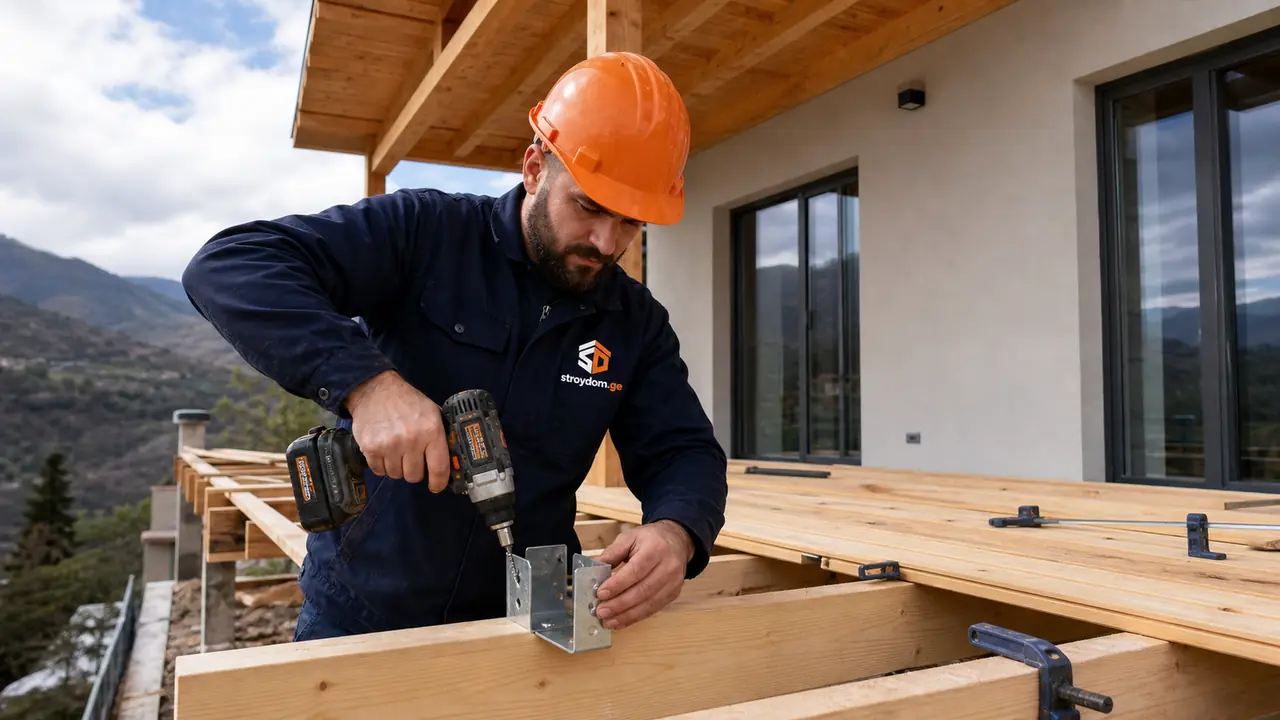
Terraces, canopies and outdoor areas
Terraces and canopies from stroydom.ge are built in Tbilisi and across Georgia as a standalone order or as part of a house or landscaping project. A terrace with a cast base, waterproofing and falls costs 220–420 ₾ per square metre. Surfaces: external porcelain 120–260 ₾/m², timber decking 150–320 ₾/m² including materials. A steel-framed canopy with polycarbonate or metal roofing is 350–750 ₾ per square metre, and a louvred pergola 900–1,800 ₾ per square metre. A barbecue area with water, power and extraction costs 3,000–9,000 ₾. The estimate is fixed after a survey.
We build terraces, canopies, pergolas and outdoor living areas at houses in Tbilisi and across Georgia: cast or piled bases, waterproofing and falls with proper drainage, decking, external porcelain tile or natural stone, steel-framed canopies with roofing, louvred pergolas, and barbecue areas with water, power and extraction.
Available as a separate order from 1,000 GEL
We take this work as a standalone order from 1,000 GEL, or as part of a turnkey house project. Inside a house project one contractor answers for the whole chain of work: one estimate and one warranty.
About the work
How does stroydom.ge deliver terraces, canopies and outdoor areas?
An outdoor living room: terrace, shade, light, water and a grill.
What is included in terraces, canopies and outdoor areas?
Base
Cast slab or piles and beams, designed for the soil and the slope of the plot.
Waterproofing and falls
Falls away from the house, waterproofed abutment detail, channels and drainage points.
Surface
Timber decking, external porcelain tile or natural stone with frost-resistant adhesive.
Canopy or pergola
Steel frame with corrosion protection, roofing in polycarbonate, metal or glass.
Services
Lighting, external-rated sockets, water to a sink, extraction over the grill.
What is terraces, canopies and outdoor areas and why is it needed?
In the Tbilisi climate the outdoor area is in use for most of the year, so a terrace is an extension of the living space rather than decoration. It has two technical weak points: the junction with the house wall and the drainage. Those, not the choice of board, decide whether the room behind that wall is still dry in two years.
So we start with the base, the falls and the waterproofing, and choose the surface and canopy on top of a sound structure.
What stages does terraces, canopies and outdoor areas consist of?
Each stage runs only after the previous one is accepted — so hidden works are never "closed" before inspection, and a mistake never has to be hunted for through screed and plaster.
- 1
Survey and levels
Levels relative to the house, slope of the plot, drainage points, orientation to the sun.
- 2
Base
Cast slab or piles with beams, reinforced for the load and the terrain.
- 3
Waterproofing and falls
Falls away from the house, abutment detail, channels and the discharge point.
- 4
Buried services
Ducts for water and power, pads and anchors for the canopy posts.
- 5
Surface
Decking, porcelain or stone laid, movement joints, edge detail.
- 6
Canopy and fit-out
Frame and roofing installed, lighting, sockets, sink and grill, commissioning.
How does stroydom.ge control quality on site?
How we work on site — materials, equipment, tolerances, documentation and acceptance of hidden works.
Water-tested before laying
Falls are checked with water before the surface goes down: a puddle under laid stone can only be fixed by lifting it.
Abutment detail
The junction with the house is a designed waterproofing detail, not tile tucked under render.
Frame designed for load
Canopies are designed for wind and snow: in Kojori and Bakuriani snow load sets the sections, not appearance.
External electrics
Sockets and fittings rated for outdoor use, on a circuit with RCD protection.
What should be accounted for in Tbilisi and Georgia?
What we account for here: seismic intensity 8 (MSK-64), hot summers and damp winters, steep terrain, older stock with timber floors and worn city networks.
Heat and materials
Dark porcelain gets hot in full sun. In the open we choose lighter tones or plan shade.
Storms
Drainage is sized for a Tbilisi downpour, not average rain: an undersized channel backs up towards the house.
Mountain sites
In Gudauri and Bakuriani snow loads on a canopy are several times higher than in Tbilisi, which calls for a different structure.
Wind
Fabric pergolas and light roofs on exposed plots need reinforced fixings back to the base.
How much does it cost and how long does it take?
Indicative price ranges in lari (₾) for standard conditions. The final estimate is fixed after measurements and specification approval.
| Item | What is included and the price |
|---|---|
| Guide prices (Tbilisi, before survey) | The figures below are a guide. The final estimate depends on area, terrain and surface type. |
| Terrace with base | Cast base, waterproofing and falls: 220–420 ₾ per square metre. |
| Surface | External porcelain 120–260 ₾/m², timber decking 150–320 ₾/m² including materials. |
| Canopy | Steel frame with polycarbonate or metal roofing: 350–750 ₾ per square metre. |
| Pergola | Structure with adjustable louvres: 900–1,800 ₾ per square metre. |
| Barbecue area | Paved area with water, power and extraction: 3,000–9,000 ₾ depending on the fit-out. |
| How we price | By square metre of base and surface; canopy, services and grill priced as separate items. |
Updated:
Ready to estimate?
Leave a request — engineer site visit, measurement and a preliminary estimate for "terraces, canopies and outdoor areas" are free.

Planning to build a house?
Start with a free consultation about your plot, floor area and budget. If you are still looking for land, tell us about a plot you are considering.
We will call within an hour, 24/7. You do not need drawings for the first conversation.
By submitting the form you agree to personal data processing. Privacy Policy
Frequently asked questions — Terraces, canopies and outdoor areas
Why does damp appear where the terrace meets the house?
The abutment. A terrace always falls away from the house and needs a dedicated waterproofing detail where it meets the wall; without it water stands at the junction and finds its way into the structure, which shows up later as blown plaster and mould in the corner of the room inside. The second cause is missing drainage: with no channel and outlet, storm water sits on the surface and works on the finish through winter.
Decking, porcelain or stone?
Timber decking is kinder underfoot and stays cooler, but needs maintenance and lasts less. External porcelain tile is the most practical: it does not fade, washes down and survives both heat and frost, though it heats up in full sun. Natural stone looks the most expensive and suits view terraces, but demands frost-resistant adhesive, correct joints and a sound base: on a poor slab it cracks first. In Tbilisi porcelain usually wins, with decking kept in the shade of a canopy.
Do canopies and terraces need permits?
It depends on area, permanence and whether the structure attaches to the house. A light pergola on the plot is usually permit-free, while a permanent canopy on foundations that adds built area may need approval, especially close to the boundary. We raise this before work starts so the structure does not complicate registering the house later.
Build the terrace with the house or afterwards?
The base and everything buried should go in with the house: the abutment waterproofing, drainage, ducts for water and power, and the pads for the canopy. The surface and canopy can follow later, once the façade is finished and plant is off the plot. A terrace built entirely after landscaping costs more, because paving has to be broken and finished details cut into.