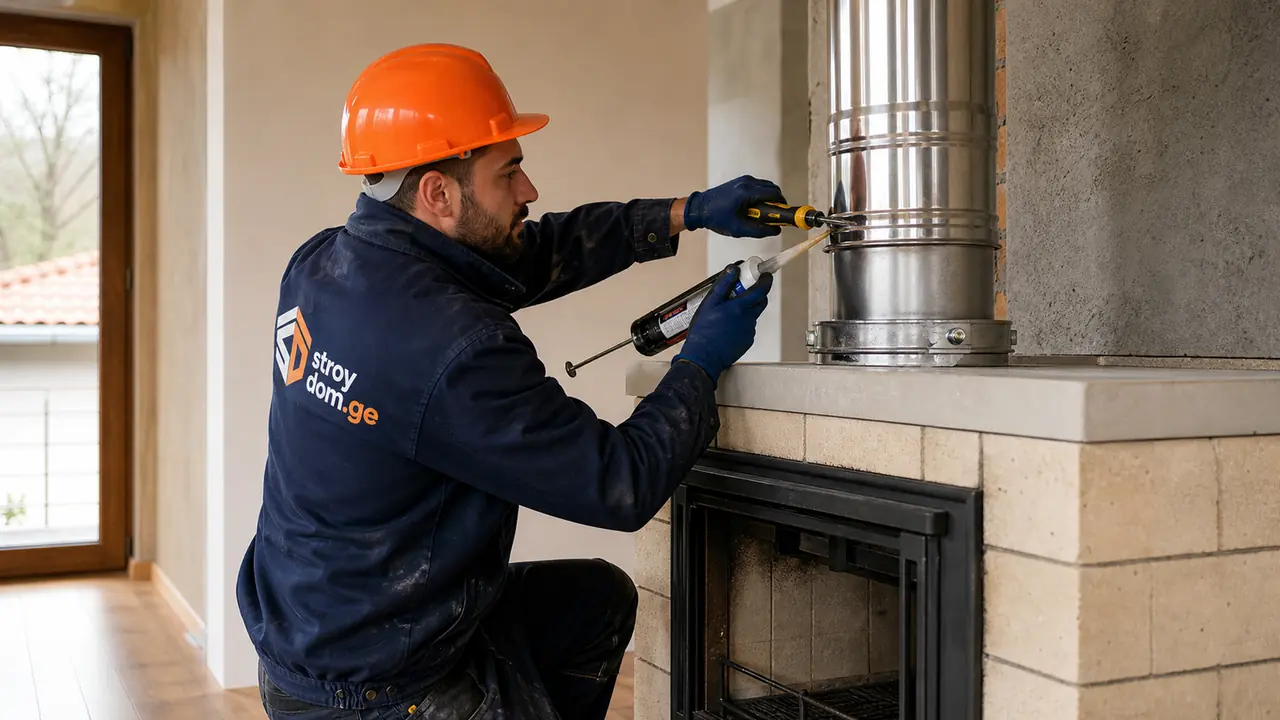
Fireplaces and flues
A closed-firebox fireplace in Tbilisi costs 4,500–12,000 ₾ at stroydom.ge, not counting the price of the firebox unit: that covers fitting the firebox, the flue and the surround. The flue costs 260–520 ₾ per linear metre, a penetration through floor or roof 400–900 ₾ each, a combustion air duct 350–800 ₾, surround and finish 1,200–5,000 ₾. The estimate follows flue sizing for the specific firebox. We take it as a standalone order or as part of a full house project.
We design and install fireplaces, stoves and flues in private houses and guest buildings in Tbilisi and across Georgia: flue diameter and height calculated for the specific firebox, closed fireboxes and stoves installed, insulated flue systems with fire-safe penetrations through floors and roof, dedicated combustion air from outside, and surrounds finished in stone, plaster or tile.
Available as a separate order from 1,000 GEL
We take this work as a standalone order from 1,000 GEL, or as part of a turnkey house project. Inside a house project one contractor answers for the whole chain of work: one estimate and one warranty.
About the work
How does stroydom.ge deliver fireplaces and flues?
Live fire without the risk: draught, flue, penetrations, surround.
What is included in fireplaces and flues?
System sizing
Firebox output for the room volume, flue diameter and height, termination point on the roof.
Base and firebox
Load-bearing base for the weight of the assembly, firebox set, recess insulated.
Flue
Insulated modular systems, inspection hatches, condensate drain, terminal with spark arrestor.
Penetrations
Fire-safe passages through floors and roof, separations, non-combustible insulation.
Surround and finish
Stone, plaster or tile finish, mantel, ventilation grilles.
What is fireplaces and flues and why is it needed?
A fireplace is the one interior feature where a mistake ends in a fire or in poisoning, so we treat it as an engineering system rather than décor. The chain of firebox, flue and combustion air is sized first, and only then is the surround chosen. Tbilisi adds its own conditions: altered shared flues, dense building with tall neighbouring walls, and mild winters in which a fireplace usually works for atmosphere more than for heat, and that changes the firebox you should buy.
What stages does fireplaces and flues consist of?
Each stage runs only after the previous one is accepted — so hidden works are never "closed" before inspection, and a mistake never has to be hunted for through screed and plaster.
- 1
Sizing and position
Room volume, firebox output, flue diameter and height, roof termination point.
- 2
Base
Floor structure checked, load-bearing base built for the weight of firebox and finish.
- 3
Combustion air
Duct from outside to the firebox, grilles, coordination with house ventilation.
- 4
Firebox and flue
Firebox installed, insulated modules assembled, inspection hatches, condensate drain.
- 5
Penetrations
Passages through floors and roof with separations and non-combustible insulation, roof weathering.
- 6
Surround and first firing
Finish, ventilation grilles, first burn with a draught test, handover briefing.
How does stroydom.ge control quality on site?
How we work on site — materials, equipment, tolerances, documentation and acceptance of hidden works.
Draught before the finish
A test burn happens before the surround is finished: reworking a flue under finished stone means taking it apart.
Separations to standard
Clearances to combustible construction are held strictly: penetrations are exactly where fires start.
Air supply is mandatory
A dedicated air duct goes in every time, because in an airtight house the fireplace will not work without it.
Documentation
Flue layout, firebox and module datasheets, first-firing record and a sweeping schedule.
What should be accounted for in Tbilisi and Georgia?
What we account for here: seismic intensity 8 (MSK-64), hot summers and damp winters, steep terrain, older stock with timber floors and worn city networks.
Shared older flues
In older buildings shafts are often altered: we test the draught with instruments before designing.
Mild winters
In Tbilisi a fireplace is usually a supplementary heat source, which allows a smaller firebox.
Dense building
Tall neighbouring walls create downdraught, so terminal height is calculated with them in mind.
Mountain houses
In Bakuriani and Gudauri a fireplace is often the heating reserve during outages: that calls for higher output and a wood store.
How much does it cost and how long does it take?
Indicative price ranges in lari (₾) for standard conditions. The final estimate is fixed after measurements and specification approval.
| Item | What is included and the price |
|---|---|
| Guide prices (Tbilisi, before sizing) | The figures below are a guide. The final estimate depends on firebox type, flue length and the complexity of the penetrations. |
| Fireplace with closed firebox | Fitting the firebox, flue and surround: 4,500–12,000 ₾, not counting the price of the firebox unit. |
| Flue | Insulated modular system: 260–520 ₾ per linear metre installed. |
| Penetration | Passage through a floor or roof with separation and weathering: 400–900 ₾ each. |
| Combustion air | Duct from outside to the firebox with grilles: 350–800 ₾. |
| Surround and finish | Stone, plaster or tile: 1,200–5,000 ₾ depending on material and complexity. |
| How we price | By assembly: firebox, flue by the metre, penetrations each, surround and commissioning separately. |
Updated:
Ready to estimate?
Leave a request — engineer site visit, measurement and a preliminary estimate for "fireplaces and flues" are free.

Planning to build a house?
Start with a free consultation about your plot, floor area and budget. If you are still looking for land, tell us about a plot you are considering.
We will call within an hour, 24/7. You do not need drawings for the first conversation.
By submitting the form you agree to personal data processing. Privacy Policy
Frequently asked questions — Fireplaces and flues
Why does a fireplace smoke into the room?
Three reasons. Insufficient draught: flue diameter or height does not suit the firebox. That is calculated before purchase, not after. Lack of air: in a house with sealed windows and an extractor running there is physically nothing for the fire to burn, so a dedicated air supply from outside is needed. And aerodynamics: a tall tree, a neighbouring house or a ridge above the terminal creates a downdraught zone. All three are checked at the design stage, not after the surround is built.
Open or closed firebox?
An open fire looks better but returns roughly a tenth of its heat to the room, pulls warm air up the flue and needs constant attention. A closed firebox with glass returns several times more, holds a burn far longer and is safe around children, while keeping the view of the fire. Where the fireplace is a heat source rather than only a feature, a closed firebox is the sensible answer.
Can a fireplace go into a finished house?
Yes, but at a higher cost and with constraints. It needs a load-bearing base, a flue route with penetrations through floors and roof, and combustion air. In a finished interior that means opening the floor, the ceiling and the roof build-up. So even when the fireplace is only a "someday" plan, it is worth building in the base, a duct for air and the route during construction.
What about flues in older Tbilisi buildings?
Shared flues in older stock have often been altered by neighbours, blocked or disconnected during refurbishments. Connecting to such a flue without checking is not acceptable: it risks downdraught and carbon monoxide reaching the neighbours. We test the draught and the condition of the shaft before designing, and the right answer is often a dedicated insulated flue instead.