Backup and off-grid power
stroydom.ge designs and installs backup and off-grid power in Tbilisi and across Georgia, as a standalone order or as part of a turnkey house. Guide prices before sizing: battery backup on critical circuits 2,500–7,000 ₾, a 5–12 kW generator with auto-transfer 6,000–16,000 ₾, a 5–10 kW solar system 9,000–20,000 ₾, 5–15 kWh of storage 4,000–14,000 ₾, stabilisation and protection 900–2,600 ₾. The final estimate depends on the load list and the hours of autonomy required.
We design and install backup and off-grid power for houses, guest buildings and commercial premises in Tbilisi and across Georgia: diesel or petrol generators with automatic transfer, battery inverters covering the critical circuits, solar panels with a hybrid inverter, plus voltage stabilisation and surge protection for the equipment.
Available as a separate order from 1,000 GEL
We take this work as a standalone order from 1,000 GEL, or as part of a turnkey house project. Inside a house project one contractor answers for the whole chain of work: one estimate and one warranty.
About the work
How does stroydom.ge deliver backup and off-grid power?
Light and water when the grid drops: pick your level of backup.
What is included in backup and off-grid power?
Load assessment
What must keep running during an outage: pump, boiler, fridge, internet, lighting, air conditioning.
Generator and transfer
Sizing, base or enclosure, automatic transfer switch, fuel supply and exhaust.
Battery inverter
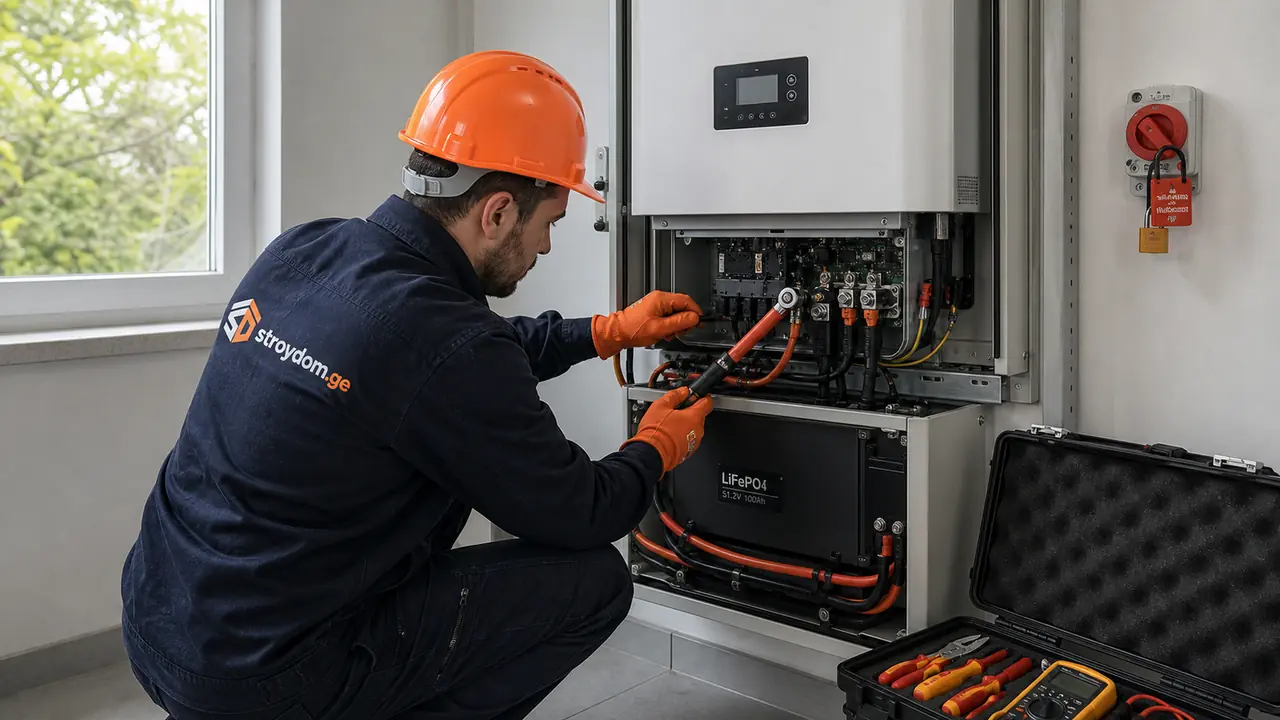
Inverter and batteries on the critical circuits: silent backup with no generator start.
Solar system
Roof panels, hybrid inverter, storage, generation metering.
Protection and stabilisation
Stabiliser, surge protection, selective circuit protection, a separate backup board.
What is backup and off-grid power and why is it needed?
Power cuts in Tbilisi and the suburbs are routine, and a house with its own water supply, a gas boiler and a borehole stops completely without electricity: the pump does not run, the boiler will not fire, the gate controls are dead. For a guest house it also means cancelled bookings. So we size backup not by the incoming supply but by the list of what has to keep working, and then choose a generator, batteries or a combination to match.
What stages does backup and off-grid power consist of?
Each stage runs only after the previous one is accepted — so hidden works are never "closed" before inspection, and a mistake never has to be hunted for through screed and plaster.
- 1
Load list
What must run during an outage and what it draws, both starting and running.
- 2
Choice of scheme
Battery, generator, solar or a combination; how many hours of backup are needed.
- 3
Board design
Circuit split, backup board, transfer scheme, discrimination between protective devices.
- 4
Routes and base
Cable to the generator, base or enclosure, exhaust, acoustic treatment, panel fixings.
- 5
Equipment installation
Generator, inverter, batteries, panels, stabiliser, surge protection.
- 6
Commissioning
Auto-start proven under load, transfer time measured, handover and service schedule.
How does stroydom.ge control quality on site?
How we work on site — materials, equipment, tolerances, documentation and acceptance of hidden works.
Tested under load
Auto-start is proven with real loads connected, not off-load. Otherwise, the first real outage becomes the test.
Separate backup board
Critical circuits are physically split off, so an outage does not drag the whole house and waste the reserve.
Ventilation and exhaust
A generator indoors means designed air supply and flue routing, not "we put it in the utility room".
Documentation
Board schematics, equipment datasheets, transfer test record, servicing and battery replacement schedule.
What should be accounted for in Tbilisi and Georgia?
What we account for here: seismic intensity 8 (MSK-64), hot summers and damp winters, steep terrain, older stock with timber floors and worn city networks.
Voltage swings
Sags and spikes are normal on suburban networks. Without a stabiliser and surge protection the backup equipment is the first casualty.
Generator noise
In dense parts of Vake and Saburtalo noise becomes a dispute with neighbours: an enclosure, a base and a considered location are part of the job.
Heat and batteries
Lithium banks lose life in heat: they go somewhere ventilated and shaded, not under a sunlit roof.
Roof for panels
Orientation, pitch and load capacity are checked before installation. On an older roof, the structure is assessed first.
How much does it cost and how long does it take?
Indicative price ranges in lari (₾) for standard conditions. The final estimate is fixed after measurements and specification approval.
| Item | What is included and the price |
|---|---|
| Guide prices (Tbilisi, before sizing) | The figures below are a guide. The final estimate depends on the load list, the hours of autonomy required and the installation location. |
| Battery backup on critical circuits | Inverter with batteries for lighting, internet, boiler and pump: 2,500–7,000 ₾ depending on capacity. |
| Generator with auto-transfer | 5–12 kW set with auto-start, board and connection: 6,000–16,000 ₾ including equipment. |
| Solar system | Panels with hybrid inverter, no storage, 5–10 kW: 9,000–20,000 ₾ installed. |
| Storage for solar | Battery bank 5–15 kWh: 4,000–14,000 ₾ by type and capacity. |
| Stabilisation and protection | Stabiliser, surge protection and backup board: 900–2,600 ₾. |
| How we price | By assembly: equipment, boards, cable runs by the metre and commissioning as separate lines. |
Updated:
Ready to estimate?
Leave a request — engineer site visit, measurement and a preliminary estimate for "backup and off-grid power" are free.

Planning to build a house?
Start with a free consultation about your plot, floor area and budget. If you are still looking for land, tell us about a plot you are considering.
We will call within an hour, 24/7. You do not need drawings for the first conversation.
By submitting the form you agree to personal data processing. Privacy Policy
Frequently asked questions — Backup and off-grid power
Generator, battery or solar: which one?
Three answers to three different problems. A battery inverter covers short outages silently and instantly (internet, lighting, boiler, pump), typically for a few hours. A generator handles long outages and heavy loads, but it is noisy and needs fuel and servicing. Solar cuts the bill and adds daytime autonomy, but does nothing at night without storage. For most Tbilisi houses a battery inverter on the critical circuits is enough; a generator makes sense where outages run long, and solar where both the bill and independence matter.
How long will the house run on batteries?
It depends what you switch on. Lighting, internet, router, fridge and a gas boiler with its pump come to roughly 0.5–1.5 kW, and a typical battery bank carries them for 4–10 hours. Air conditioning, an electric cylinder, a hob or a borehole pump draw kilowatts on start and drain the bank in tens of minutes. Those either move to the generator or are deliberately left out of the backup. That is why sizing starts with a list, not with equipment.
Do solar panels pay off in Georgia?
There is enough sunlight in eastern Georgia, and panels visibly cut daytime consumption, especially where summer cooling loads are high. Payback depends on the tariff, on how much of your usage is during the day, and on whether you add storage: batteries are expensive and stretch the return. We cost two honest scenarios (panels for the bill, and panels for autonomy) because those are different systems at different prices.
When should backup power be designed in?
Alongside the house wiring, before finishing. Backup needs its own board, dedicated circuits to the critical loads, a cable route to the generator position and a base for it, all of which means chases, containment and a foundation. It can be retrofitted, but then the wiring runs in trunking and the list of protected circuits shrinks to what is already distributed.