Demolition and site clearance
Demolition in Tbilisi and across Georgia is priced by cubic metre at stroydom.ge: machine demolition with rubble loaded costs 55–110 ₾ per cubic metre of building volume, hand dismantling on tight sites 130–260 ₾, reinforced foundation breakout 180–350 ₾. Waste removal to a tip costs 45–90 ₾ per cubic metre, clearance and grubbing 12–30 ₾ per m². Disconnections and neighbour protection are separate items. Demolition is part of a full build project and prepares the footprint for new foundations.
We demolish old houses, extensions, garages and outbuildings in Tbilisi and across Georgia: survey and service disconnection, machine demolition or piece-by-piece dismantling on tight sites, breakout of foundations and old retaining walls, crushing and removal of construction waste, grubbing up, levelling and preparation of the footprint for new foundations.
Available as a separate order from 1,000 GEL
We take this work as a standalone order from 1,000 GEL, or as part of a turnkey house project. Inside a house project one contractor answers for the whole chain of work: one estimate and one warranty.
About the work
How does stroydom.ge deliver demolition and site clearance?
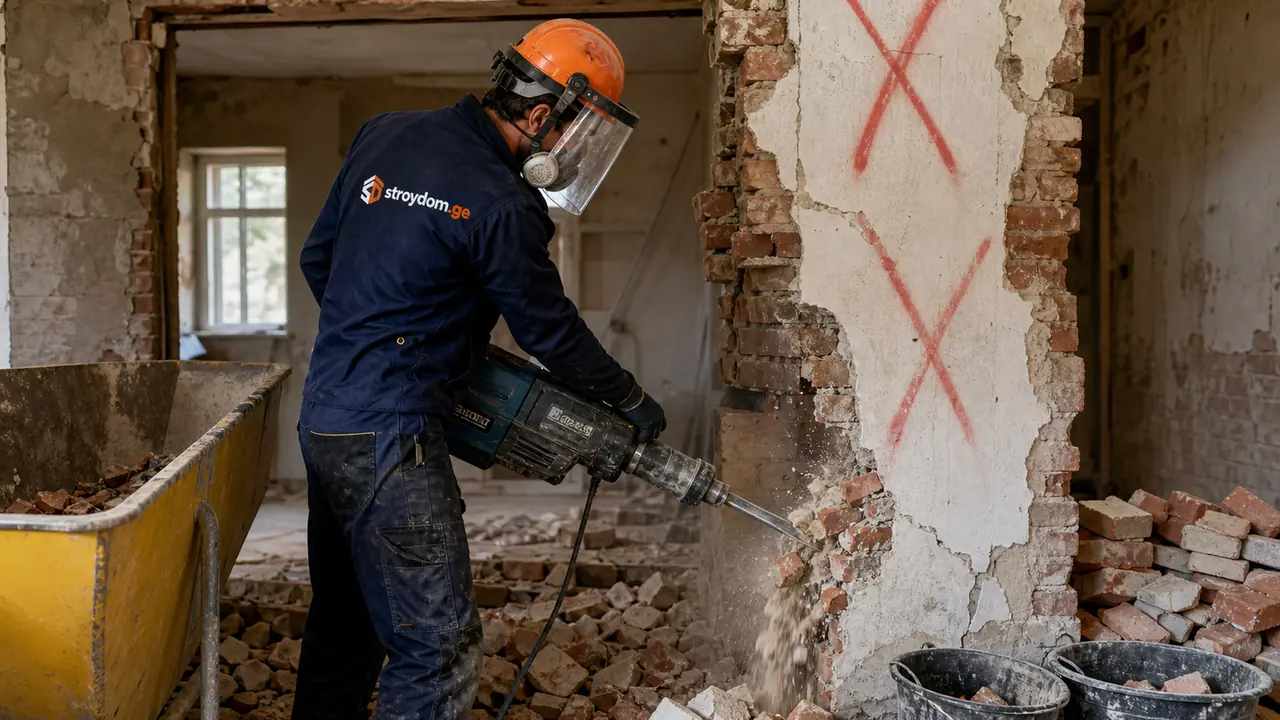
Clearing the plot for a new build: demolition, removal, levelling.
What is included in demolition and site clearance?
Survey
Structure assessed, asbestos identified, condition of neighbouring buildings, service layout.
Service disconnection
Electricity, gas, water and drainage disconnected and capped before work starts.
Demolition
Excavator with shears, or hand dismantling where neighbours are immediately adjacent.
Foundations and walls
Breakout of concrete bases, old retaining walls and pits.
Removal and levelling
Crushing, sorting, tipping with documentation, grubbing up and levelling for the new build.
What is demolition and site clearance and why is it needed?
Site clearance is the first job of the full cycle and the one where false economy shows up most. A building demolished "however it went" leaves rubble that was never removed, foundation debris in the new footprint and a soured relationship with the neighbours, and sometimes a problem with the permit for the new build as well. So we run demolition as a designed operation: survey, disconnection, method selection, recording the neighbours’ condition, and only then the machines.
What stages does demolition and site clearance consist of?
Each stage runs only after the previous one is accepted — so hidden works are never "closed" before inspection, and a mistake never has to be hunted for through screed and plaster.
- 1
Survey and status
Structure, materials, asbestos, the building’s status in the register, restrictions in the quarter.
- 2
Service disconnection
Electricity, gas, water and drainage disconnected by the utilities with paperwork.
- 3
Site set-up
Hoarding, protection of adjoining structures, photographic record of their condition, plant routes.
- 4
Demolition
Machine or hand dismantling top-down with water suppression for dust.
- 5
Foundations
Breakout of bases, pits and old retaining walls, reinforcement recovered.
- 6
Removal and levelling
Crushing, sorting, tipping, grubbing up vegetation, levelling for the new design.
How does stroydom.ge control quality on site?
How we work on site — materials, equipment, tolerances, documentation and acceptance of hidden works.
Paperwork first
Disconnections and the building’s status are confirmed on paper before plant arrives.
Neighbours photographed first
The state of adjoining walls and fences is recorded in advance: otherwise every old crack becomes yours.
Dust controlled
Water suppression during demolition: on a tight street it is the only way to stay on terms with the neighbours.
Waste with documentation
Tipping is evidenced: fly-tipping is a fine for the landowner.
What should be accounted for in Tbilisi and Georgia?
What we account for here: seismic intensity 8 (MSK-64), hot summers and damp winters, steep terrain, older stock with timber floors and worn city networks.
Asbestos
Soviet-era buildings often contain asbestos sheeting and pipes: these are separated and removed on their own.
Narrow streets
In older districts a tipper cannot reach the plot: compact plant plus transfer loading changes both programme and price.
Slopes
On sloping sites demolition changes the loading on retaining walls, so their condition is assessed before work starts.
Historic fabric
In some Tbilisi quarters demolition is restricted or the façade must be retained. This is checked before the estimate.
How much does it cost and how long does it take?
Indicative price ranges in lari (₾) for standard conditions. The final estimate is fixed after measurements and specification approval.
| Item | What is included and the price |
|---|---|
| Guide prices (Tbilisi, before survey) | The figures below are a guide. The final estimate depends on construction type, plant access and the volume to be removed. |
| Machine demolition | House or outbuilding with rubble loaded: 55–110 ₾ per cubic metre of building volume. |
| Hand dismantling | Piece-by-piece demolition on tight sites: 130–260 ₾ per cubic metre. |
| Foundation breakout | Reinforced concrete base broken out: 180–350 ₾ per cubic metre. |
| Waste removal | Loading and tipping: 45–90 ₾ per cubic metre depending on access. |
| Clearance and grubbing | Shrubs, trees and levelling: 12–30 ₾ per square metre. |
| How we price | By cubic metre of demolition and removal; disconnections, protection of neighbours and grubbing up as separate items. |
Updated:
Ready to estimate?
Leave a request — engineer site visit, measurement and a preliminary estimate for "demolition and site clearance" are free.

Planning to build a house?
Start with a free consultation about your plot, floor area and budget. If you are still looking for land, tell us about a plot you are considering.
We will call within an hour, 24/7. You do not need drawings for the first conversation.
By submitting the form you agree to personal data processing. Privacy Policy
Frequently asked questions — Demolition and site clearance
Is a permit needed to demolish?
As a rule yes, and it is the first thing to deal with: demolishing a permanent structure touches the register and the neighbours, and in Tbilisi’s historic quarters there may be restrictions on the whole building or its façade. Unauthorised demolition complicates getting the permit for the new build, which defeats the purpose of clearing the plot. We check the status of the building before any plant arrives.
How do you demolish when the neighbour is a metre away?
Piece by piece. In the dense fabric of old Tbilisi an excavator bucket is unusable: the structure is dismantled top-down with hand and compact tools, the adjoining wall protected and vibration controlled. It costs more and takes longer than machine demolition, but less than repairing a cracked neighbouring wall and explaining it in court. The method is chosen at survey, not on site.
What happens to the old foundation?
It depends on what comes next. Sometimes part of the old base can serve the new structure. That is checked by opening it up and assessing the concrete. More often it is simpler to break it out entirely, because its geometry and depth do not match the new design and reinforced concrete gets in the way of excavation. The decision is taken with the new structural design, not separately.
Where does the waste go, and how much is there?
Demolishing a 100 m² house leaves roughly 60–120 cubic metres of rubble: dozens of tipper loads and a noticeable share of the estimate. Concrete is crushed, metal separated and sold on, the rest goes to a licensed tip with documentation. Cost depends heavily on whether a tipper can reach the plot: on the narrow streets of Vake material has to be moved by hand or with compact plant.