Gas equipment
stroydom.ge builds and services plant rooms in Tbilisi and across Georgia as a standalone order or as part of a turnkey house. The price covers the calculation, pipework drawing, boiler and safety group installation, flue, manifolds, pressure test, commissioning and handover briefing. The equipment itself, the gas operator’s work, preparing the plant room, radiators and circuit pipework are priced separately. The estimate is fixed once the calculation is done.
We build and service plant rooms for private houses in Tbilisi and across Georgia: the boiler is sized from the building heat loss rather than guessed from floor area; we install the pipework, flue and safety group, tie the boiler into the radiator, underfloor and hot-water circuits, commission the system and service it afterwards. Connection to the gas main and metering are carried out by the licensed gas distribution operator. We prepare the property for their visit and support you through the process.
Available as a separate order from 1,000 GEL
We take this work as a standalone order from 1,000 GEL, or as part of a turnkey house project. Inside a house project one contractor answers for the whole chain of work: one estimate and one warranty.
About the work
How does stroydom.ge deliver gas equipment?
The whole plant room: from choosing the boiler to commissioning and servicing. The mains connection is made by a licensed operator.
What is included in gas equipment?
Sizing the output
Calculated from heat loss, allowing for insulation, glazing and the local climate. An oversized boiler is as bad as an undersized one: it short-cycles and wears out faster.
The plant room
Volume, height, window, supply ventilation, non-combustible finishes: we check the room against the requirements before the boiler is bought, not after.
Pipework and safety group
Pumps, expansion vessel, safety valve, pressure gauge, filters and isolation valves, assembled to a drawing rather than to whatever fitted.
Flue
Concentric or twin-pipe, with the correct fall, condensate drain and a terminal position clear of windows and neighbouring buildings.
Tying in the circuits
Radiators, underfloor heating and the hot-water cylinder through a low-loss header or manifold, with controls and weather compensation.
Commissioning and service
Pressure testing, combustion and heating-curve setup, handover briefing, seasonal servicing.
What is gas equipment and why is it needed?
The plant room is the one part of a house where a mistake costs safety rather than money. Yet almost every problem we are called to was created at installation, not at failure: the boiler sized by floor area instead of heat loss, a flue terminated wherever was convenient, a safety group assembled off-drawing, an expansion vessel too small for the system volume. A boiler that has run for a year shows none of it.
It all surfaces in the second or third heating season.
What stages does gas equipment consist of?
Each stage runs only after the previous one is accepted — so hidden works are never "closed" before inspection, and a mistake never has to be hunted for through screed and plaster.
- 1
Heat loss calculation
Envelope, glazing and local climate: the real demand of the building.
- 2
Equipment selection
Boiler type and output, hot-water strategy, controls, whether a buffer is needed.
- 3
The room
Checking volume, height, window, supply ventilation and finishes against plant room requirements.
- 4
Flue
Sized and installed with a condensate drain and correct clearance from openings.
- 5
Pipework
Boiler, pump group, manifolds, expansion vessel, safety group and valves.
- 6
Circuits
Radiators, underfloor heating, hot-water cylinder; balancing and control setup.
- 7
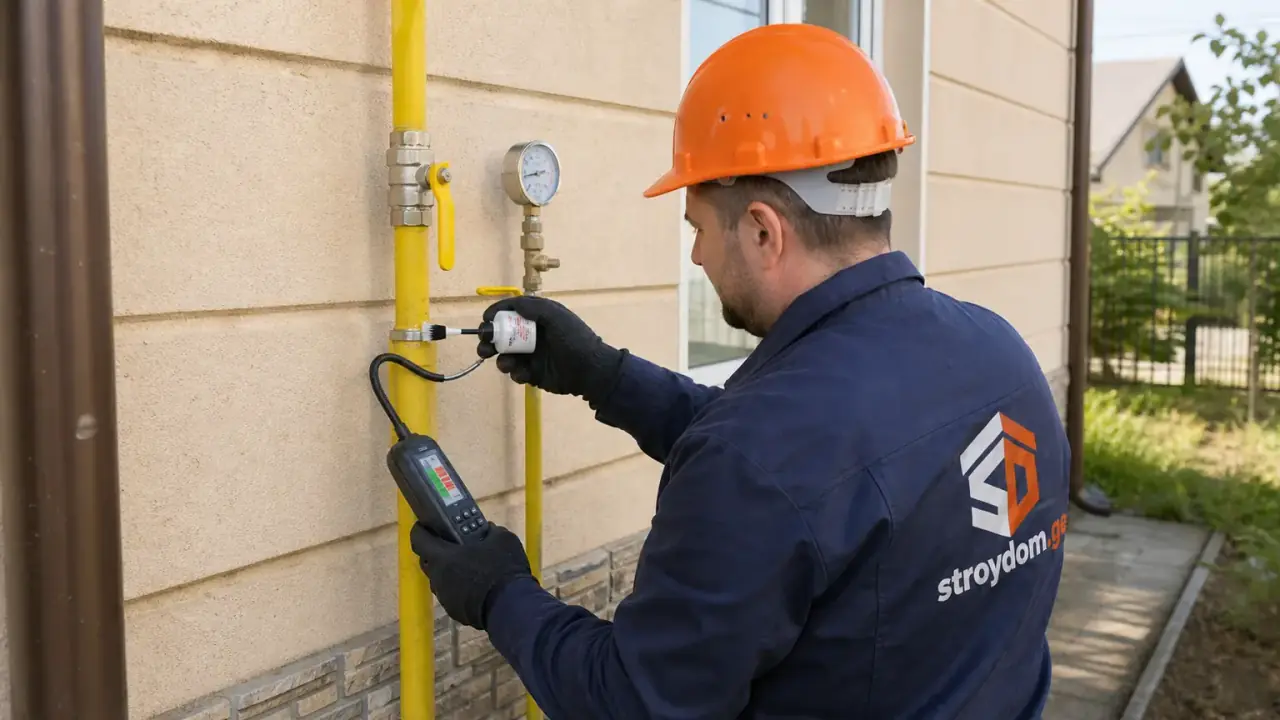
Pressure test
The system is tested before chases and screed are closed, and leaks are dealt with.
- 8
Start-up and handover
Commissioning once the operator has turned the gas on, briefing, documents, warranty.
How does stroydom.ge control quality on site?
How we work on site — materials, equipment, tolerances, documentation and acceptance of hidden works.
Output by calculation
We calculate heat loss rather than multiplying floor area by a coefficient. An oversized boiler short-cycles and wears faster than an undersized one.
Drawing before installation
The pipework is drawn and agreed with you. A plant room assembled ad hoc cannot be maintained: within a year nobody remembers what goes where.
Room requirements first
Volume, height, window, supply air and non-combustible finishes are checked before equipment is bought. Otherwise there is nowhere lawful to put the boiler.
Flue and openings
The terminal position is set relative to windows, doors and neighbouring structures. An error here means combustion products indoors, not an aesthetic issue.
Tested before closing up
The system stays under pressure until screed and plaster go on. A leak found now costs almost nothing; found later it costs an opened floor.
Clear boundaries
Everything up to the gas cock belongs to the network operator; everything after it is ours, and that is written into the contract so there is no argument if something goes wrong.
What should be accounted for in Tbilisi and Georgia?
What we account for here: seismic intensity 8 (MSK-64), hot summers and damp winters, steep terrain, older stock with timber floors and worn city networks.
Mains pressure and outages
In the Tbilisi suburbs gas pressure sags in winter, and a boiler with a narrow modulation range starts cutting out. That is allowed for at selection rather than patched later with settings.
Mild but long season
The Tbilisi heating season is mild and long. A condensing boiler pays back better here than in a cold climate: it spends most of its time at low return temperatures, where its efficiency is highest.
Hard water
On some properties the water scales the secondary heat exchanger of a combi boiler. Either we fit a softener or we design around a cylinder from the outset.
No gas nearby
Where there is no main, we cost the alternatives honestly: electric boiler, heat pump or bulk LPG. Sometimes connecting to the network costs more over the equipment lifetime than an off-grid solution.
How much does it cost and how long does it take?
Indicative price ranges in lari (₾) for standard conditions. The final estimate is fixed after measurements and specification approval.
| Item | What is included and the price |
|---|---|
| What the price covers | Calculation, pipework drawing, boiler and safety group installation, flue, manifolds, pressure test, commissioning and handover briefing. |
| What drives it | Boiler output and type, number of circuits, whether there is a cylinder and underfloor heating, flue length and type, readiness of the room. |
| Priced separately | The equipment itself, the gas operator’s work, preparing the plant room, radiators and circuit pipework. |
| Servicing | Annual servicing is a separate item for houses we built: the system is known and documented. |
Updated:
Ready to estimate?
Leave a request — engineer site visit, measurement and a preliminary estimate for "gas equipment" are free.

Planning to build a house?
Start with a free consultation about your plot, floor area and budget. If you are still looking for land, tell us about a plot you are considering.
We will call within an hour, 24/7. You do not need drawings for the first conversation.
By submitting the form you agree to personal data processing. Privacy Policy
Frequently asked questions — Gas equipment
Do you connect the house to the gas main yourselves?
No, and no contractor may do that on their own authority. Tapping the main, fitting the meter and sealing it are the exclusive remit of the licensed gas distribution operator; in Georgia the sector is regulated by GNERC and distribution is handled by the network company. We do everything around it: plant room design, the room itself, flue, pipework, circuits and commissioning once gas is on. We also support you in dealing with the network operator.
How do you decide which boiler is needed?
From the building heat loss, not the floor area. We account for the envelope, insulation type and thickness, glazed area, ceiling heights and the climate of the specific location. Then the type: a condensing boiler is more economical in the mild Tbilisi climate and works better with underfloor heating; a conventional room-sealed boiler is cheaper and simpler to service. A system boiler with a cylinder gives steadier hot water; a combi is more compact and cheaper.
The boiler is noisy, short-cycles and keeps shutting down. Why?
Usually the output is oversized: the boiler heats a small volume of water quickly, shuts down and fires again. That is not a fault but a sizing error, and it shortens the life of the heat exchanger. It is fixed with a low-loss header or buffer vessel, correct minimum-output settings, sometimes by changing to a model with a wider modulation range. The other common cause is air in the system and a wrongly set pump.
Does a boiler really need servicing every year?
Yes, and it is not a formality. Cleaning the heat exchanger and burner, checking the electrodes, expansion vessel pressure, safety valve operation and flue draught. Without it efficiency drops, gas consumption rises, and a share of failures land at the start of the heating season when service teams are overloaded. Manufacturers generally require annual servicing to keep the warranty valid.
Do you take on boiler repairs outside a build?
Yes, as a standalone order from 1,000 GEL. A plant room needs a design, and one visit with a toolbox is not enough, so we start with a survey and the calculation.