Wine cellars and marani
Wine cellars and marani from stroydom.ge are built at houses and guest buildings in Tbilisi and across Georgia as a standalone order or as part of a house project. A below-ground room of 15–25 m² with waterproofing, climate and finishes costs 18,000–45,000 ₾. Walls, slab, external tanking and drainage are 550–1,100 ₾ per square metre. Setting a qvevri, with the pit, connections and floor falls, costs 1,200–3,000 ₾ per vessel excluding the qvevri itself. Climate and ventilation with CO₂ removal is 2,200–6,000 ₾, a cooling unit from 3,500 ₾. Finishes and racking cost 350–900 ₾ per square metre.
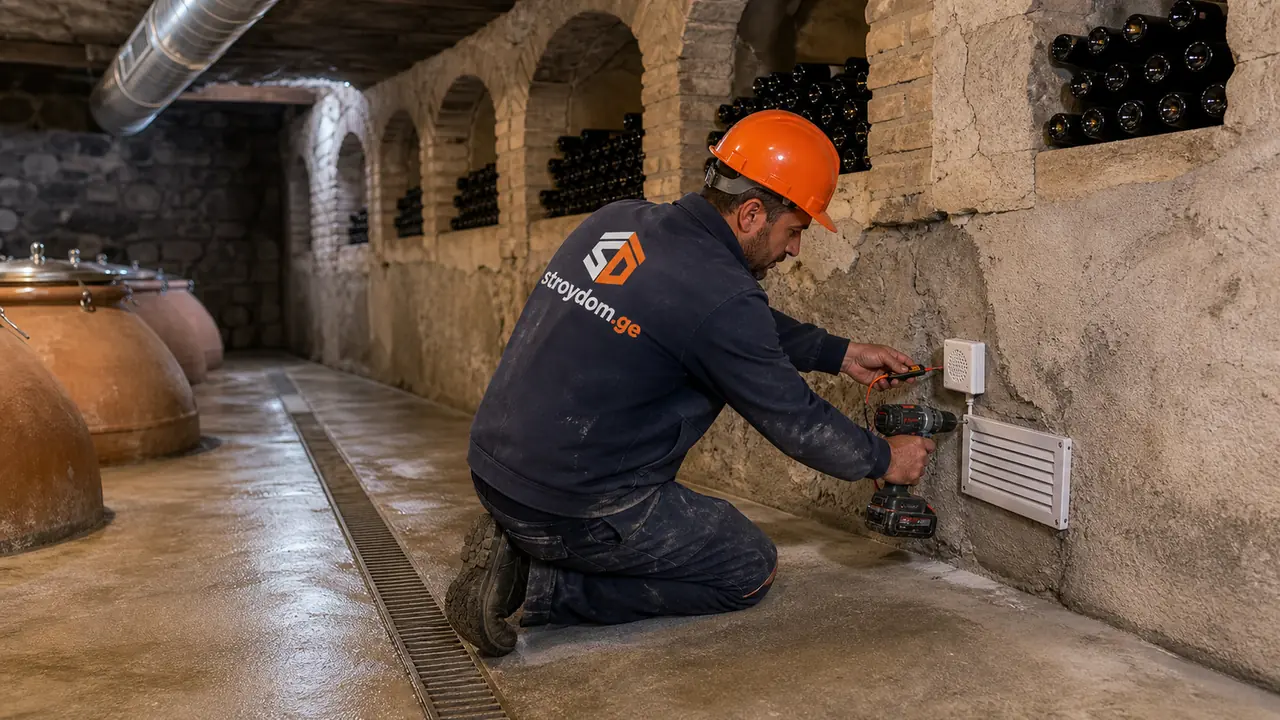
We build wine cellars and traditional marani at private houses and guest buildings in Tbilisi and across Georgia: a below-ground room with waterproofing and drainage, qvevri set and connected, a stable 12–16 °C with no swings, supply and extract ventilation, timber or concrete racking, stone finishes and a tasting area with its own entrance.
Available as a separate order from 1,000 GEL
We take this work as a standalone order from 1,000 GEL, or as part of a turnkey house project. Inside a house project one contractor answers for the whole chain of work: one estimate and one warranty.
About the work
How does stroydom.ge deliver wine cellars and marani?
A marani or wine cellar: waterproofing, climate, qvevri, finishes.
What is included in wine cellars and marani?
Structure and waterproofing
Below-ground walls and slab, external and internal waterproofing, perimeter drainage.
Qvevri
Pits prepared, vessels set and connected, floor falls to the gully.
Climate
Insulation, 12–16 °C and 60–75% humidity held steady, a cooling unit where needed.
Ventilation
Supply and extract with no draughts, carbon dioxide removed during fermentation.
Finishes and storage
Stone, brick or plaster, racking for bottles and barrels, lighting, tasting area.
What is wine cellars and marani and why is it needed?
In Georgia a marani is part of how people live rather than a decorative extra, and it is built with the house: a below-ground room with qvevri needs waterproofing, drainage and ventilation decided at foundation stage. Mistakes here are expensive: damp ruins both the wine and the structure, and underestimated ventilation during fermentation is a danger to life. So we treat the cellar as a services room first (waterproofing, climate, air change) and only then move on to stone and racking.
What stages does wine cellars and marani consist of?
Each stage runs only after the previous one is accepted — so hidden works are never "closed" before inspection, and a mistake never has to be hunted for through screed and plaster.
- 1
Position and capacity
Number of qvevri or bottles, how it will be used, relation to the house, separate entrance.
- 2
Structure
Below-ground walls and slab designed for earth and water pressure, tied to the house foundations.
- 3
Waterproofing and drainage
External tanking, perimeter drainage, internal protection against rising damp.
- 4
Qvevri and floors
Pits, vessels set and connected, floor falls to the gully, acid-resistant finish.
- 5
Climate and ventilation
Insulation, supply and extract, CO₂ removal, cooling unit where required.
- 6
Finishes and fit-out
Stone or plaster, racking, soft lighting, tasting area, CO₂ detector.
How does stroydom.ge control quality on site?
How we work on site — materials, equipment, tolerances, documentation and acceptance of hidden works.
Waterproofed from outside
The external layer goes on before backfill: a cellar cannot be fully protected from the inside afterwards.
CO₂ under control
Extract low at floor level, supply high, and a detector with an alarm wherever qvevri are worked.
Falls and gully
The floor is laid to a gully: washing qvevri means water, and a flat floor gives it nowhere to go.
No light or vibration
Racking is isolated from plant, lighting is warm and switchable: light and shaking age wine.
What should be accounted for in Tbilisi and Georgia?
What we account for here: seismic intensity 8 (MSK-64), hot summers and damp winters, steep terrain, older stock with timber floors and worn city networks.
Groundwater
On low ground in Digomi and along watercourses the table sits high: drainage and external tanking are essential.
Slopes
On sloping ground the cellar can be cut into the hillside. That means less excavation, but it needs a retaining wall and drainage.
Heat
Any part above ground level warms up in summer: without insulation the climate drifts past 20 °C.
Joined to the house
Where a marani adjoins living space, ventilation is kept separate, because fermentation smells must not reach the house.
How much does it cost and how long does it take?
Indicative price ranges in lari (₾) for standard conditions. The final estimate is fixed after measurements and specification approval.
| Item | What is included and the price |
|---|---|
| Guide prices (Tbilisi, before survey) | The figures below are a guide. The final estimate depends on depth, groundwater, the number of qvevri and the finishes. |
| Complete cellar | Below-ground room of 15–25 m² with waterproofing, climate and finishes: 18,000–45,000 ₾. |
| Structure and waterproofing | Walls, slab, external tanking and drainage: 550–1,100 ₾ per square metre. |
| Qvevri installation | Pit, setting, connections and floor falls: 1,200–3,000 ₾ per vessel, excluding the qvevri itself. |
| Climate and ventilation | Supply and extract with CO₂ removal and detector: 2,200–6,000 ₾; cooling unit from 3,500 ₾. |
| Finishes and racking | Stone or plaster, racking and lighting: 350–900 ₾ per square metre. |
| How we price | By square metre of the room; qvevri, climate and finishes as separate items. |
Updated:
Ready to estimate?
Leave a request — engineer site visit, measurement and a preliminary estimate for "wine cellars and marani" are free.

Planning to build a house?
Start with a free consultation about your plot, floor area and budget. If you are still looking for land, tell us about a plot you are considering.
We will call within an hour, 24/7. You do not need drawings for the first conversation.
By submitting the form you agree to personal data processing. Privacy Policy
Frequently asked questions — Wine cellars and marani
How does a marani differ from a wine cellar?
A marani is the winemaker’s working room: qvevri are set into the floor, there is space for processing grapes, drainage, floor falls and ventilation designed for fermentation. A wine cellar is storage for finished bottles and barrels at stable temperature and humidity. They are often combined, but the requirements differ: a marani must take washing down and CO₂ release, while a cellar needs steady climate and freedom from light and vibration.
How dangerous is carbon dioxide during fermentation?
It is the main risk in a marani and the reason ventilation cannot be done by eye. CO₂ is heavier than air, collects low down around the qvevri mouths and displaces oxygen without warning, and there have been fatal cases. So we design extract at low level, supply at high level, and where qvevri are worked regularly, a CO₂ detector with an alarm. This is not optional and not somewhere to save money.
What temperature is needed, and is cooling required?
For storage, 12–16 °C with minimal seasonal swing and 60–75% humidity: dry air shrinks corks, excess humidity mildews labels. A below-ground cellar in Tbilisi ground holds that almost by itself, provided it is properly insulated and waterproofed. A dedicated cooling unit is needed where the room is partly above ground, faces the sun, or adjoins living space.
Can a cellar be added to a finished house?
A below-ground one, effectively no: it means excavating under existing foundations, which is difficult and risky for the building. What is realistic is either a separate structure on the plot or a ground-floor room converted for storage with a cooling unit. That is why marani and cellars are planned with the house, alongside the foundation waterproofing; retrofitting costs several times more.